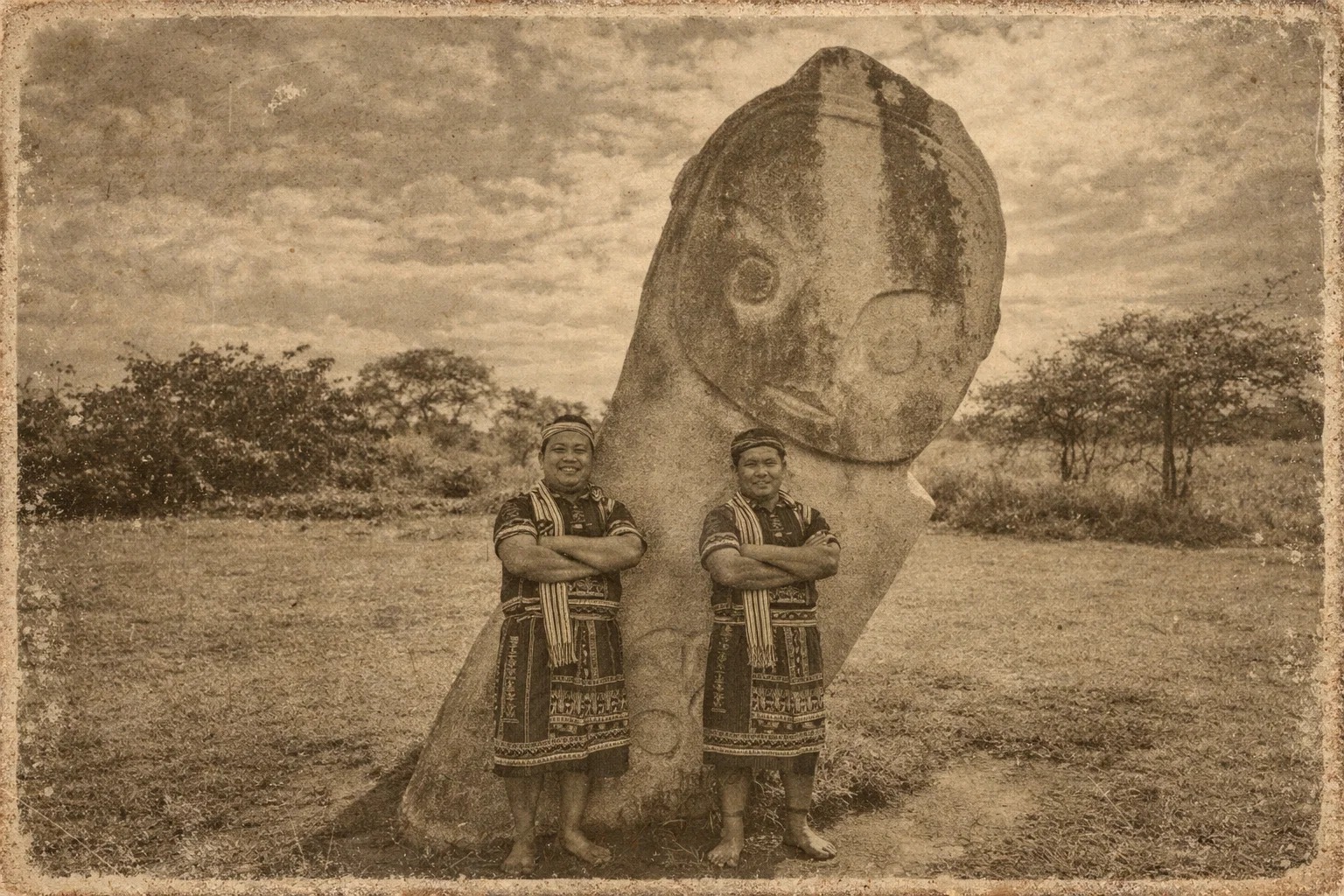
Few archaeological regions in Indonesia preserve mysteries as profound as the megalithic complexes of Central Sulawesi. If Gunung Padang remains the subject of debate, and Borobudur’s builders are well known, the megaliths of Lore Lindu present a far more fundamental enigma: who created them, when were they constructed, and why did the civilisation responsible for these monumental works disappear without leaving any written record?
The megalithic complexes scattered across the Napu, Behoa (Besoa), Bada, and Palu valleys are now recognised as one of the largest concentrations of megalithic remains in Southeast Asia. According to UNESCO World Heritage nomination data, at least 2,000 megalithic remains are distributed across 118 archaeological sites covering approximately 156,127 hectares. These include anthropomorphic stone statues, kalamba (giant stone vats), tuatena (stone lids), stone mortars, dolmens, cup-marked stones, carved stones, stone circles, and stone burial chambers.
The sheer scale of these remains makes Lore Lindu far more than a conventional archaeological site. It is a cultural landscape that attests to the existence of a complex society long before the emergence of the historical kingdoms of Sulawesi.
The First Documentation: Adriani and Kruyt
Scientific research into the megaliths of Central Sulawesi began at the close of the nineteenth century.
In 1898, two Dutch missionaries, Nicolaus Adriani and Albert Christiaan Kruyt, published a travel report entitled Van Poso naar Parigi en Lindoe. In this account, they documented the existence of numerous large stone structures discovered in the inland regions of Poso, Lore, and Lindu. The publication is widely regarded as the first scientific documentation of Central Sulawesi’s megalithic heritage.
Kruyt was not, in fact, an archaeologist. He was an ethnographer and anthropologist who spent decades living among the communities of Poso and Lore. Yet it was precisely this close engagement with local society that made his observations exceptionally valuable.
In his monumental work De West Toradjas in Midden Celebes, published in 1938, Kruyt recorded a variety of ancient remains, including kalamba in Gimpu, stone altars in Mapahi, and numerous oral traditions preserved among the Lore people. He became the first scholar to attempt to connect these stone monuments with the social history of the interior communities of Central Sulawesi.
Kruyt’s approach was fundamentally ethnographic. He did not merely describe the physical appearance of artefacts; he also collected myths, legends, and oral narratives explaining the origins of the stone statues.
Although many of his interpretations are now considered open to revision, Kruyt’s documentation remains one of the principal foundations of megalithic research in Central Sulawesi.
Walter Kaudern and the First Systematic Survey
If Kruyt was the pioneer of early documentation, Walter Kaudern was the scholar who transformed the study of Central Sulawesi’s megaliths into a systematic scientific endeavour.
Kaudern was a Swedish zoologist and ethnographer who conducted expeditions throughout Sulawesi between 1917 and 1920. His research was financed by Crown Prince Gustaf Adolf of Sweden. Although his original objective was zoological investigation, he soon became fascinated by the cultural remains of Central Sulawesi.
Over the course of nearly four years, Kaudern travelled through the remote valleys of the Lore region. He measured, mapped, sketched, and photographed hundreds of megalithic monuments.
His findings were published in 1938 in the landmark volume Megalithic Finds in Central Celebes, which remains a primary reference for almost all subsequent research on the megaliths of Central Sulawesi.
The strength of Kaudern’s work lay in its methodology. He:
- Produced detailed measurements of statues and kalamba;
- Compiled maps of archaeological sites;
- Recorded the local names of individual monuments;
- Collected oral traditions from local communities;
- Compared the Central Sulawesi evidence with megalithic traditions elsewhere in Southeast Asia.
Many monuments that have since deteriorated or suffered damage can now be reconstructed through Kaudern’s meticulous documentation.
For archaeologists, Kaudern’s publication possesses a significance comparable to the classic archaeological expedition reports of Egypt or South America, as it preserves the condition of the sites before the disruptions of the modern era.
The Largest Megalithic Complex in Indonesia?
Today, Indonesian archaeologists broadly agree that the Lore Lindu region constitutes one of the largest megalithic complexes in the Indonesian archipelago.
Central Sulawesi’s Megalithic Landscape
The Lore Lindu megalithic landscape contains one of Southeast Asia’s largest concentrations of megalithic remains, spread across 118 archaeological sites and comprising approximately 2,000 megalithic objects.
| Region | Sites |
|---|---|
| Bada | 35 |
| Behoa/Besoa | 32 |
| Napu | 29 |
| Palu | 22 |
118
Approximately 2,000
Source: UNESCO World Heritage Centre.
In total, 118 archaeological sites contain approximately 2,000 megalithic objects.
These figures far exceed the concentration of megalithic remains found in many other parts of Indonesia.
Beyond their quantity, the diversity of monument types is equally remarkable.
Kalamba: The Unique Giant Stone Vats
Perhaps the most distinctive monuments of Central Sulawesi are the kalamba.
A kalamba is a large cylindrical stone container carved from a single massive block of stone. Some examples exceed one metre in diameter and are estimated to weigh several tonnes.
Excavation research indicates that these structures served as communal secondary burial containers, repositories for human remains after the completion of initial burial rites.
Kalamba are found principally in:
- The Bada Valley;
- The Besoa Valley;
- The Napu Valley.
Comparable stone vessels have been documented in Laos, Assam in India, Sarawak, and parts of northern Sumatra. Nevertheless, the kalamba of Central Sulawesi possess distinctive characteristics that set them apart from these other traditions.
Stone Statues Without Parallel
Alongside the kalamba, researchers have devoted considerable attention to the anthropomorphic stone statues.
Among the most famous are:
- Palindo;
- Langke Bulawa;
- Maturu.
These statues exhibit highly distinctive features:
- Exceptionally large heads;
- Prominent circular eyes;
- Simplified body forms;
- Anatomically disproportionate proportions;
- In some cases, explicitly depicted genitalia.
This artistic style is virtually unparalleled elsewhere in Indonesia.
Consequently, scholars generally regard the sculptural tradition of Lore as an indigenous cultural development rather than a simple product of external influence.
How Old Are They?
The most important question remains unanswered.
Kruyt and Kaudern worked before the advent of radiocarbon dating and could only estimate the age of the monuments through cultural comparison.
Modern research has provided new clues.
Excavations at the Entovera Site in the Besoa Valley produced a radiocarbon date of approximately 2,170 years Before Present (BP), indicating that the area was inhabited at least as early as the second century BCE.
However, the age of settlement is not necessarily identical to the age of the statues.
For this reason, archaeologists remain cautious when assigning definitive dates to the entire megalithic complex.
According to studies incorporated into the UNESCO nomination dossier, the megalithic tradition of Lore may have begun developing around 3,000 years ago and reached its peak during the Early Metal Age, approximately 2,500–1,500 years ago.
This suggests that many of the megaliths of Central Sulawesi were erected at a time when large parts of the Indonesian archipelago were still characterised by local prehistoric communities.
An Enduring Mystery
More than 125 years after Kruyt first recorded their existence, and nearly ninety years after Kaudern published his monumental study, the central question remains unchanged:
Who built the Lore megaliths?
There are no inscriptions.
There is no written tradition.
No historical kingdom can be directly linked to the sites.
What remains are thousands of massive stones scattered across the mountain valleys of Central Sulawesi.
From the perspective of modern archaeology, this is precisely what makes Lore Lindu extraordinary. It is not merely a collection of artefacts but evidence that a society once flourished in the interior of Sulawesi with sophisticated social organisation, advanced stone-working technology, elaborate mortuary practices, and a highly developed cosmological worldview.
Kruyt regarded the monuments as traces of an ancient Torajan people. Kaudern viewed them as manifestations of a unique megalithic tradition without known parallel. Twenty-first-century research increasingly suggests that both scholars may have only glimpsed the surface of a civilisation far more complex than previously imagined.
And to this day, the stone statues of Bada, Besoa, and Napu continue to stand beneath the skies of Sulawesi—silent, yet persistently challenging modern scholarship to discover who created them.