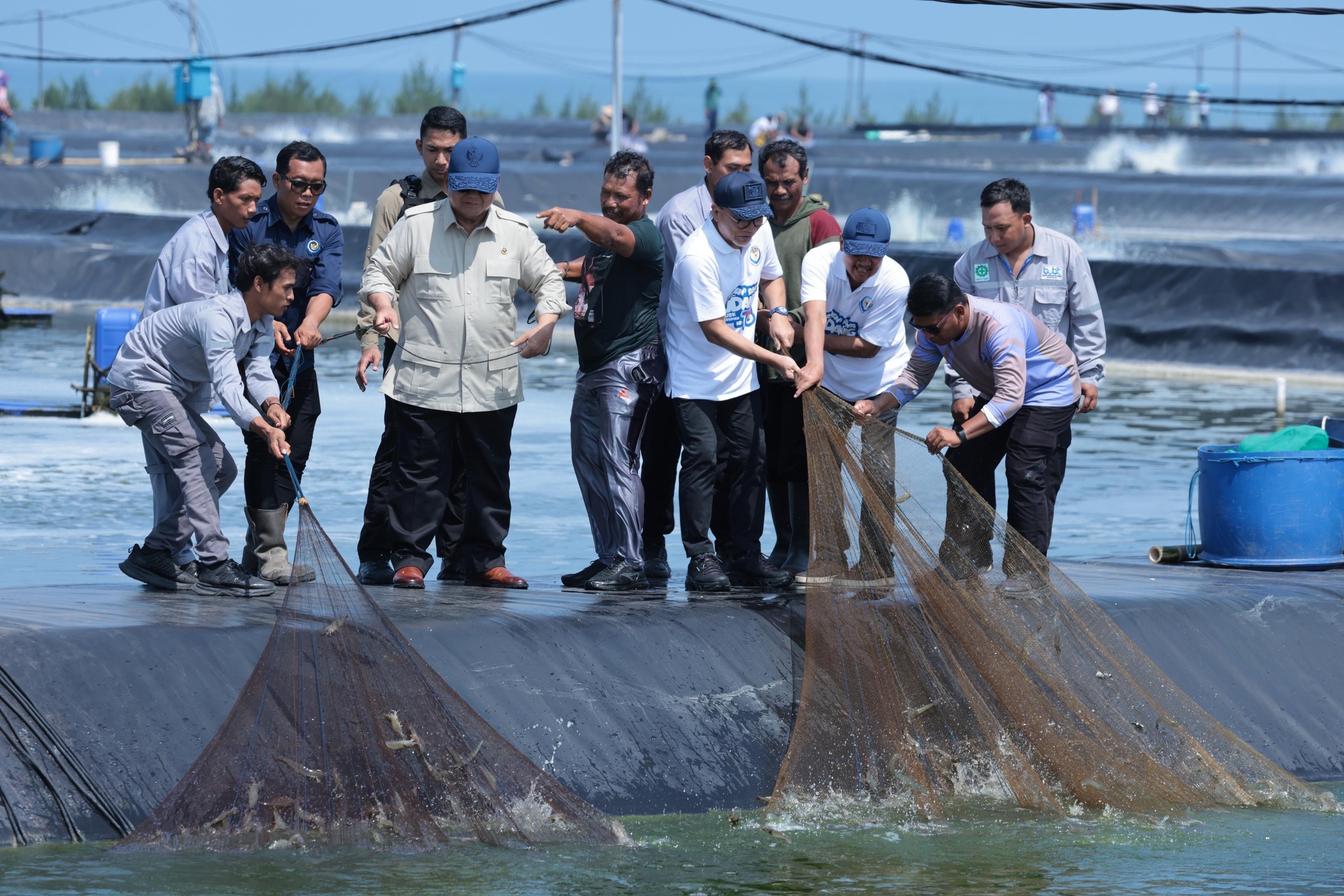
KEBUMEN, Central Java — Under the harsh midday sun of southern Java, hundreds of workers in rubber boots dragged heavy nets through shimmering ponds as crates of shrimp were hauled onto trucks bound for export markets. Standing at the edge of the vast aquaculture complex in Tegalretno Village on Sunday, Indonesia’s president, Prabowo Subianto, framed the harvest not merely as a local economic success, but as a symbol of the country’s broader ambitions for industrial growth and national self-sufficiency.
The shrimp cultivation estate, spread across 65 hectares in Petanahan District, Kebumen Regency, employs roughly 650 local workers and produces as much as 40 tons of shrimp per hectare, according to figures cited by the president. At current market prices — approximately Rp 70,000 per kilogram — the operation represents a lucrative corner of Indonesia’s expanding maritime economy.
But the visit quickly evolved into something larger than a ceremonial harvest.
“In the coming months, we will accelerate the construction of productive projects,” Mr. Prabowo said before workers, local officials and business operators gathered around the ponds. “Productive means projects that create jobs for the people, generate added value for the nation’s foreign exchange earnings, and increase the income of ordinary Indonesians.”
The remarks echoed a central theme of Mr. Prabowo’s presidency: that Indonesia’s immense natural wealth has too often enriched only a narrow elite while vast segments of the population remain economically vulnerable.
Indonesia, the world’s largest archipelago, possesses some of the globe’s richest reserves of nickel, fisheries, palm oil and other commodities. Yet successive governments have grappled with corruption, inefficiency and uneven development that critics say have allowed state revenues and public wealth to “leak” away through opaque networks of patronage and weak oversight.
Mr. Prabowo, a former defense minister and longtime political figure, has increasingly adopted the language of economic nationalism since assuming office. On Sunday, he returned to a phrase that has become central to his rhetoric.
“Indonesia is truly very rich,” he said. “But too much of our wealth leaks away. This leakage must stop.”
He pledged to work “with all possible effort” to ensure that the country’s resources are enjoyed not by “a select few,” but by the broader population.
The shrimp farm itself reflects a growing push by the Indonesian government to modernize aquaculture, an industry seen as critical to food security, exports and rural employment. Coastal regions across Java, Sulawesi and Sumatra have become targets for large-scale fisheries development as Jakarta seeks to position Indonesia as a leading global seafood supplier.
For residents of Tegalretno, however, the significance of the project was less ideological than practical. The promise of stable wages in a rural district where many families depend on seasonal agriculture has altered the rhythms of village life. Workers crowded around the ponds described the harvest season as one of the busiest and most profitable periods they had experienced in years.
Whether projects like the Kebumen shrimp estate can become a durable model for equitable development remains uncertain. Economists have long warned that large-scale resource industries in Indonesia often struggle to balance rapid growth with environmental sustainability and fair distribution of profits.
Still, on the muddy embankments of Petanahan, amid the smell of seawater and diesel engines, the president offered a vision of an Indonesia where the nation’s abundance could finally be converted into prosperity shared more broadly among its people. ***