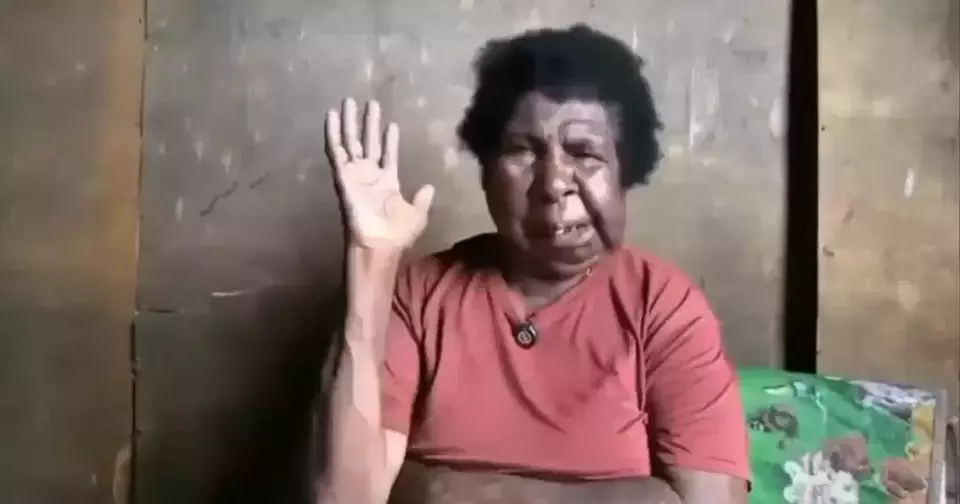
MERAUKE, South Papua — Inside a modest wooden home on the southern edge of Papua, an Indigenous woman pointed toward a broken stove that no longer worked. Smoke from firewood drifted through the small kitchen as she described the regret she says has followed her for months.
Her name is Yasinta Moiwend, though in villages across Merauke she is better known as Mama Sinta.
For years, Mama Sinta’s face had become associated with resistance to Indonesia’s national strategic food estate project in South Papua — a massive government initiative that has stirred fierce debate between advocates of economic development and Indigenous groups fearful of losing ancestral land.
Now, she says she feels she was exploited.
In a video statement circulating widely this week, Mama Sinta said she never gave permission for her image or remarks to be used in the documentary film Pesta Babi, which portrays opposition to large-scale land clearing in Merauke.
“It was done without my permission, without my knowledge,” she said. “I was shocked when the film was shown and my face appeared at the front. They treated me like a puppet, displayed without my consent.”
Her comments add a new dimension to the increasingly contentious debate surrounding the government’s food estate ambitions in South Papua — a project officials describe as essential to national food security, but which environmental activists and legal advocacy groups have criticized as a threat to Indigenous communities and fragile ecosystems.
Mama Sinta said she was initially invited, alongside other members of the Marind Indigenous community, to speak out against land clearing linked to the project. She joined meetings and traveled to cities including Jayapura, Makassar, and Jakarta.
But after months of involvement, she said, she felt she gained nothing in return.
“I received nothing from them,” she said. “I swear before God, I knew nothing about the Pesta Babi film. They simply used me.”
She also said she was distressed to discover that her face had appeared on promotional posters for the documentary without her approval. Since then, she said, she has cut off communication with the legal advocacy group LBH Papua Pusaka.
Mama Sinta has since apologized to the government for her earlier statements rejecting the national strategic project in Papua.
“I apologize because it was not entirely my own will,” she said. “I was influenced by their invitation.”
In Merauke — where vast wetlands and grasslands have become central to Indonesia’s ambitions for agricultural expansion — disputes over land are about more than environmental policy or zoning maps. They are also about poverty, isolation, and the hopes many villagers place in economic opportunity.
Mama Sinta gestured toward the condition of her home, describing a daily reality far removed from the political narratives surrounding the project.
“We support it because in this village we have nothing,” she said. “Our only hope is that the government and companies will help local people find work and a better life.”
Her remarks come as the administration of Prabowo Subianto accelerates a series of large-scale food security initiatives as part of its broader agenda of national self-sufficiency.
In South Papua, however, the project continues to expose a deeper tension: between promises of development and fears of dispossession, between state ambitions and Indigenous voices that many say have too rarely been fully heard.