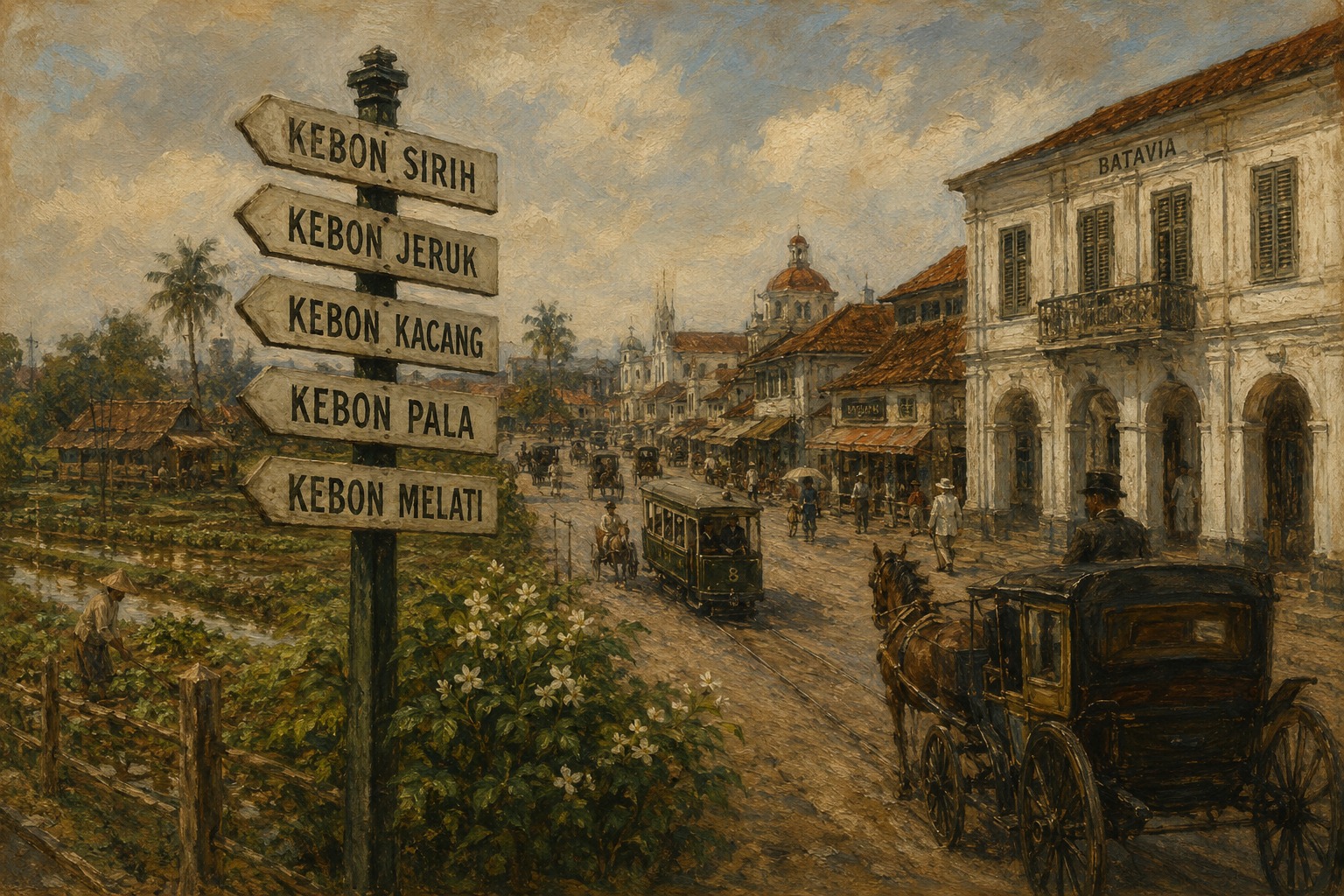
JAKARTA — In a city of glass towers, toll roads, and relentless traffic, it is easy to miss the quiet persistence of an older landscape. Yet scattered across Indonesia’s capital are names that read like botanical remnants: Kebon Sirih, Kebon Jeruk, Kebon Kacang, Kebon Pala, Kebon Melati.
They sound like neighborhoods—and they are. But they also function as a kind of historical archive, preserving within a single word a time when Jakarta was not yet Jakarta, but Batavia: a colonial port city surrounded not by concrete, but by gardens, orchards, and plantation fields.
A City Built on Gardens That Are Gone
The word kebon—from the Malay and Betawi vernacular for “garden” or “plantation”—once described a lived reality rather than a memory. During the Dutch colonial period, particularly under the Dutch East Indies administration, large parts of Batavia’s outskirts were cultivated land.
These were not ornamental gardens. They were productive spaces: fields of chilies, patches of cassava, groves of citrus, and rows of nutmeg and other export commodities that tied the colony to global trade routes. Even humble crops like peanuts and sirih leaves gave their names to places that would eventually become dense urban districts.
“Kebon Jeruk,” for instance, reflects a time when citrus trees were widespread in the western outskirts of Batavia. “Kebon Kacang” evokes fields of peanuts. “Kebon Sirih” recalls the betel plant once essential to local social rituals across Java and the archipelago.
What is striking is not only the agricultural past itself, but how casually it was recorded in language—less as official planning and more as everyday geography.
Batavia: Where the City Ended and the Fields Began
In colonial Batavia, urban design was sharply divided. The Dutch administrative center, anchored in what is now Jakarta Kota, followed European urban models: canals, fortified buildings, and rigid street grids.
But beyond those formal boundaries, the city softened into something more fluid. Land ownership was fragmented among colonial estates, Chinese merchant families, and local communities. The result was a patchwork landscape where agriculture and settlement overlapped.
Unlike modern zoning systems, naming practices were organic. People referred to areas by what they saw growing there. A field of melati flowers became Kebon Melati. A grove dominated by nutmeg became Kebon Pala. Over time, these descriptive labels hardened into place names.
There was no intention, at the time, that these names would endure into the 21st century. Yet they did.
When the Gardens Disappeared, the Names Remained
As Batavia expanded and modernized in the late colonial period and later under Indonesian governance, the physical gardens gradually disappeared. Railways, roads, housing developments, and commercial districts replaced farmland. Population density increased, and the city pushed outward in all directions.
But while the land changed, the language did not.
The names remained attached to administrative units—villages, then urban neighborhoods. In some cases, residents continued using the old names even after the landscapes they described had vanished entirely.
Today, walking through Kebon Jeruk or Kebon Kacang offers little visual clue of agricultural life. Instead, one finds traffic congestion, shopping districts, and dense housing. The gardens, if they still exist at all, survive only in fragments: a roadside tree here, a narrow strip of green there.
A Linguistic Fossil in a Megacity
Urban historians often describe place names as “linguistic fossils,” and Jakarta offers one of Southeast Asia’s most vivid examples. The persistence of kebon names reflects how cities remember differently than people do—not through monuments alone, but through everyday language that becomes normalized to the point of invisibility.
For Jakarta’s residents, these names are simply directions, addresses, and administrative labels. Yet embedded within them is a quiet narrative of transformation: from agrarian outskirts to colonial port city to sprawling megacity.
It is a transformation that never fully erased its earlier layers. It simply built over them.
What Remains Beneath the Asphalt
If there is a paradox in Jakarta’s “kebon” neighborhoods, it is this: the gardens are gone, but they continue to structure how people move through the city. Commuters pass through Kebon Sirih on their way to government offices. Traffic flows through Kebon Jeruk toward highways leading out of the capital. Markets bustle in Kebon Kacang, where no peanuts are grown anymore.
The land has changed, but the names insist on continuity.
And in that insistence lies a reminder: cities are never fully modern, nor fully erased of their past. They are layered constructions, where even the most ordinary words can carry centuries of history—quietly, persistently, like an unfinished garden that refuses to disappear.